
The Brief Is the Research: Why Your Questions Determine Your Answers
By Mark Amin, Co-Founder and Lead Researcher at xplorit.io with 30 years experience in market and user research in Asia-Pacific
Get the brief right, and even simple research can unlock sharp, decision-ready insights. Get it wrong, and you’ll get data that looks impressive and tells you nothing new.
That is the part most teams underestimate. The research brief is often treated like admin: a quick email, a recycled template, a rushed note sent to get the project moving. But the brief does not just start the research. It defines it.
What gets asked. Who gets asked. How it gets asked. And, crucially, what the results can and cannot tell you. That matters because qualitative research continues to grow as organisations recognise that numbers alone rarely explain the why behind consumer behaviour. It also matters because better briefs help teams move faster without confusing speed for rigour.[navosagent]
The uncomfortable truth
Research rarely fails with fireworks. It fails quietly.
You get charts, percentages, quotes, and a tidy debrief. Everyone nods, the deck gets circulated, and then nothing changes. That is usually not a data problem. It is a framing problem.
If the brief says “test this campaign,” “understand our audience,” or “get feedback on this concept,” it is not yet asking a research question. It is describing a task. A sharper brief goes one layer deeper: what is stopping this audience from choosing the brand today, what would make this proposition feel worth switching for, or what specific barrier is depressing conversion?[displayr]
That shift from task to intent is where better decisions begin. It is also the point at which market research becomes useful to marketers, not just interesting to researchers.
What a rigorous brief actually includes
Most weak briefs skip the thinking and jump straight to execution. A strong one usually has four parts.
1. The decision
The first question is not “what do we want to know?” It is “what decision will this research inform?” If the findings cannot influence a pricing call, campaign direction, messaging choice, launch decision, or proposition refinement, the project is already drifting.[displayr]
2. A real hypothesis
Even quantitative projects need a point of view. Perhaps the team believes low consideration is caused by weak differentiation. Perhaps it suspects the new creative is clear but not motivating. A hypothesis does not lock the answer in place. It gives the research something meaningful to test.
3. The right audience
“Adults 18–45” is not a target. It is a panic response. Good briefs define who matters to the decision and who does not. Ask the wrong people and the findings will be beautifully presented, statistically neat, and strategically useless.[displayr]
4. The right method for the question
Not every project needs both qual and quant. And not every project should start with one before the other. The better question is simpler: what exactly needs to be answered, and what method is most fit for purpose?
If the team needs to explore motivations, language, unmet needs, or friction points, qualitative approaches may be the stronger option. If it needs to measure incidence, validate a pattern, compare segments, or size an opportunity, quantitative approaches may be more appropriate. Good briefs do not default to methods. They choose them deliberately.
Visual: What a good brief actually does
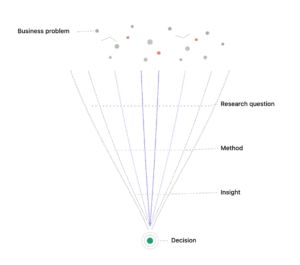
A good brief creates a clean path from business problem to decision. If the question is fuzzy, everything downstream gets blurry.
The mistakes that quietly ruin research
Most bad research does not look bad. That is what makes it dangerous.
-
Leading questions. “Which of these features do you like most?” is often just a polite way of asking respondents to validate an internal assumption.[displayr]
-
Ambiguous objectives. “Understand perceptions of the brand” sounds sensible until someone asks which perceptions, among whom, and in what buying context.
-
Wrong audience definition. Testing a premium offer with the wrong audience segment is an efficient way to learn the wrong lesson.
-
Method-first thinking. “Let’s run a survey” is not a strategy. It is a reflex.
These mistakes rarely kill a project outright. They do something sneakier. They bend the research toward what the team already half-believed. That is how misleading certainty gets made.
Where AI helps, and where it absolutely does not
AI is genuinely useful in the briefing stage. It can turn rough thoughts into a more structured brief, suggest question areas, identify gaps, and compress the time spent assembling first drafts. In other words, it is very good at reducing friction.[marketresearch]
But it still cannot decide what matters most to the business. It does not know which strategic trade-off is live in the organisation, which stakeholder assumption needs pressure-testing, or which uncertainty is actually worth paying to reduce. That is where human judgement remains non-negotiable.[redrattlercreative]
The smart use of AI is not to replace thinking. It is to give the thinking a better starting point.
When the brief goes wrong, the cost shows up later
A weak brief does not usually produce a report that looks obviously broken. It produces a campaign that tested well but underperforms in market, a product feature customers claimed to like but never use, or a segmentation that sounds sophisticated but changes nothing in execution.
The pattern is painfully consistent: the research answered the question it was asked. It just was not the question that mattered.
That is why bad briefs are expensive. Not because the research budget was wasted, but because the decisions made after the research were built on the wrong frame.
Three things to bring to the next research meeting
-
Start with the decision, not the deliverable. Ask what decision this work is informing before discussing sample size, questionnaires, or timelines.
-
Interrogate the question. Check whether the brief contains a genuine uncertainty or a dressed-up assumption.
-
Choose the method, do not inherit it. Qual or quant is not a matter of habit. It is a fit-for-purpose call tied to the decision at hand.
Marketers who do those three things will almost always get better answers, faster, because they will be solving the right problem before anyone opens a survey link or drafts a discussion guide.
The bottom line
The quality of research is not determined by the slickness of the platform, the length of the questionnaire, or the prettiness of the final deck. It is determined much earlier than that.
It is determined in the brief.
Most tools focus on speeding up execution. Better ones help teams think more clearly before execution begins. That is the difference between research that decorates a meeting and research that changes a decision.
Start your free trial and experience a brief-first approach to AI research.
Footnotes & References
navosagent: Research and Metric, “Qualitative Research Trends Reveal Powerful Brand Truths,” 2026. The article cites qualitative research growth at 7.2% CAGR and argues that brands are leaning more heavily on qualitative work to explain the “why” behind behaviour.researchandmetric
marketresearch: Humanr.ai, “Research Briefing AI for Knowledge Management Teams,” 2026. This article argues that the brief is a high-leverage AI use case because AI can collapse information gathering while humans focus on judgement and source validation.humanr
displayr: Octopus Intelligence, “How to write a good market research brief and avoid those pitfalls,” 2024. Useful for the core components of a strong brief: objectives, audience, questions, methodology, and avoiding leading assumptions.octopusintelligence
researchandmarkets: Jobs After AI, “AI Toolkit for Market Research Analysts: 6 Tools,” 2026. Used to support the point that AI can accelerate briefing and workflow structure, but still requires explicit handoffs and human oversight.jobsafterai
redrattlercreative: NCC Group, “The Expedition Debrief: How to Structure Human Judgment in AI-Augmented Pentests,” 2026. While not about market research specifically, it supports the broader point that human judgement must be deliberately structured into AI-assisted workflows.